Published: Sep 19, 2026, 8:44 AM
Read Time: 8 min
0:00
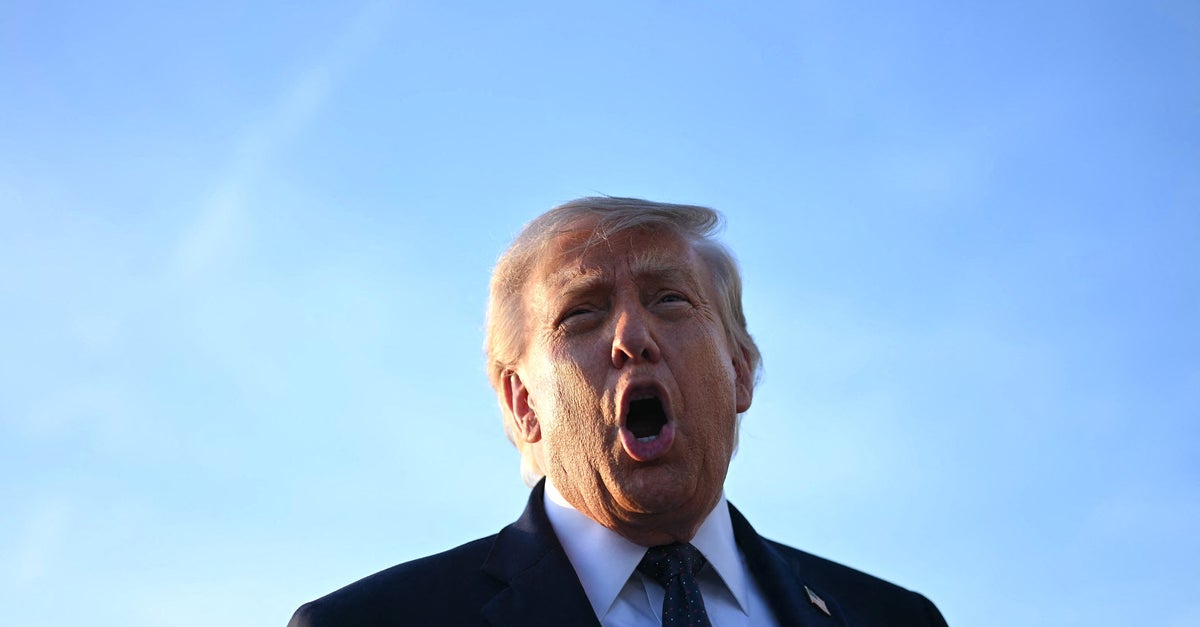
U.S. President Donald Trump addresses the media on the tarmac after arriving at Paris Orly Airport, en route to a dinner celebrating the 250th anniversary of U.S. independence, on June 17, 2026. MANDEL NGAN via Getty Images
WASHINGTON – President Donald Trump’s latest trade threat would throw the country into a massive recession, ending economic relations with 95 countries and territories — from China to Tawain to Germany to Israel — while further exacerbating, not helping, the nation’s budget woes.
“It’d be catastrophic,” said Scott Lincicome, a trade analyst at the Cato Institute.
“Markets would crater immediately. The country would enter a recession,” said University of Michigan economist Justin Wolfers, adding that the long-term effects would be even worse. “Fifty years later, the U.S. would be much poorer than it otherwise would be.”
Advertisement
Trump has repeatedly claimed in recent days that ending trade relations with countries that export more to the United States than they import would somehow generate vast amounts of cash for the U.S. government.
“If we stopped Trading with every country that we have a Deficit with, which is most of them, we would make, at least, 1.5 Trillion Dollars a year,” he wrote in Wednesday social media post.
The claim, and Trump’s insistence he will one day act on it, has received very little attention, likely because it is so nonsensical it’s difficult to imagine it could ever actually come to pass. It is nonetheless noteworthy that the president ― a man with vast powers over trade, diplomacy and war ― continues to wholeheartedly believe something so untethered from reality.
Advertisement
International trade is done not by the government, but by American individuals and companies buying and selling from counterparts in other countries. Ending that trade would not reduce the U.S. budget deficit at all and, in fact, would make it far worse.
“It’s all wrong, so we can ignore it,” said Douglas Holtz-Eakin, a conservative economist with the American Action Forum and formerly the director of the Congressional Budget Office. “It’s a non-starter. He’s not going to do it, he just says it.”
Trump’s White House did not respond to HuffPost queries on the matter.
Trump began his latest episode of mispresenting how international trade works in a Sept. 4 social media post, following a stronger-than-expected jobs report, in which he again demanded that the Federal Reserve lower interest rates.
Advertisement
“LOWER THE RATE OR I’LL STOP TRADING WITH COUNTRIES WITH WHICH WE HAVE A DEFICIT, which the U.S. Supreme Court, in its ridiculous and very costly Tariff decision, strongly acknowledged ‘the President’ has an absolute right to do. IT’S BETTER THAN TARIFFS!” Trump wrote.
He repeated that threat speaking with reporters during his $7.2 million, taxpayer-funded golf vacation at his resort in Doonbeg, Ireland.
“I’ll have no choice. We don’t want to have deficits with nations. We want to have surpluses or at least break-evens,” he said on Sept. 13 at the airport in Shannon just before the flight back to Washington.
Advertisement
Three days later, after the Fed raised interest rates despite Trump’s demands, he renewed his threat and added that doing so would generate money to let him pay down the national debt, too.
“If we wanted to get rid of deficits, which we could do with the swipe of the pen with every country, we’d make a trillion and a half dollars a year,” he told reporters traveling with him to a rally in North Carolina. “We’d pay off our debt. We’d do all sorts of things. But we haven’t chosen to do that. But at some point, we will.”
Trump elaborated on that theory in a follow-up question: “If we lose $50 billion a year with a country, and we say, ‘We’re not going to trade with you anymore,’ we don’t lose $50 billion a year. It’s very simple. Right?”
Advertisement
Economists say he could not be any more wrong.
First, trade is, by definition, not a zero-sum game. If Americans can no longer purchase goods from a country and have $50 billion a year unspent, it is because they don’t have $50 billion worth of goods they were trying to acquire.
And second, just because Americans are not spending $50 billion on goods from a particular country — or $1.5 trillion on goods from 95 countries — does not mean the U.S. government’s financial picture would improve by a penny. The only way Trump could use that “saved” money to “pay off our debt” would be to force Americans to turn it over at a 100% tax rate.
“He’s confusing the finances of the U.S. government with the finances of Americans,” Wolfers said.
Trump’s scheme to end trade with countries with which the U.S. runs a trade deficit would also devastate American manufacturers and farmers who rely on exports.
Advertisement
The 95 countries and territories with which the United States ran a trade “deficit” in 2025 make up just 40% of all countries and territories as defined by the U.S. Commerce Department, but account for some 80% of total trade, according to a HuffPost analysis.
Of that, $3 trillion are imports, many of which are raw materials or goods needed by U.S. manufacturers, and $1.5 trillion are exports — manufactured products and farm goods that Americans sell abroad.
Ending that trade would hurt all those domestic businesses, some drastically, while also causing a recession and slashing tax revenues, making the government’s budget problem even worse.
Advertisement
“He’d pour fuel on the fire his tariffs and Iran war started, forcing prices on Americans’ daily needs up even more and cutting us off from resources we need for manufacturing and construction,” said Andrew Bates, who worked in the United States Trade Representative’s office in the Obama administration and then in the White House under President Joe Biden.
“When the president wants to punish Iran for its misdeeds, he cuts it off from the rest of the world. When he wants to help the American economy, he talks about cutting it off from the rest of the world,” Wolfers said. “It’s hard to believe that these ideas both make sense.”
Holtz-Eakin, for one, said Trump says so many ridiculous things that he no longer bothers to analyze much of what comes from the president, under the assumption that a truly deranged policy would likely be blocked.
Advertisement