
Traders work after a Federal Open Market Committee (FOMC) meeting on the floor of the American Stock Exchange (AMEX) at the New York Stock Exchange (NYSE) in New York, US, on Wednesday, Sept. 16, 2026.
U.S. stock futures edged higher early Friday, after the major averages rose following Wednesday's first Federal Reserve interest rate hike in three years.
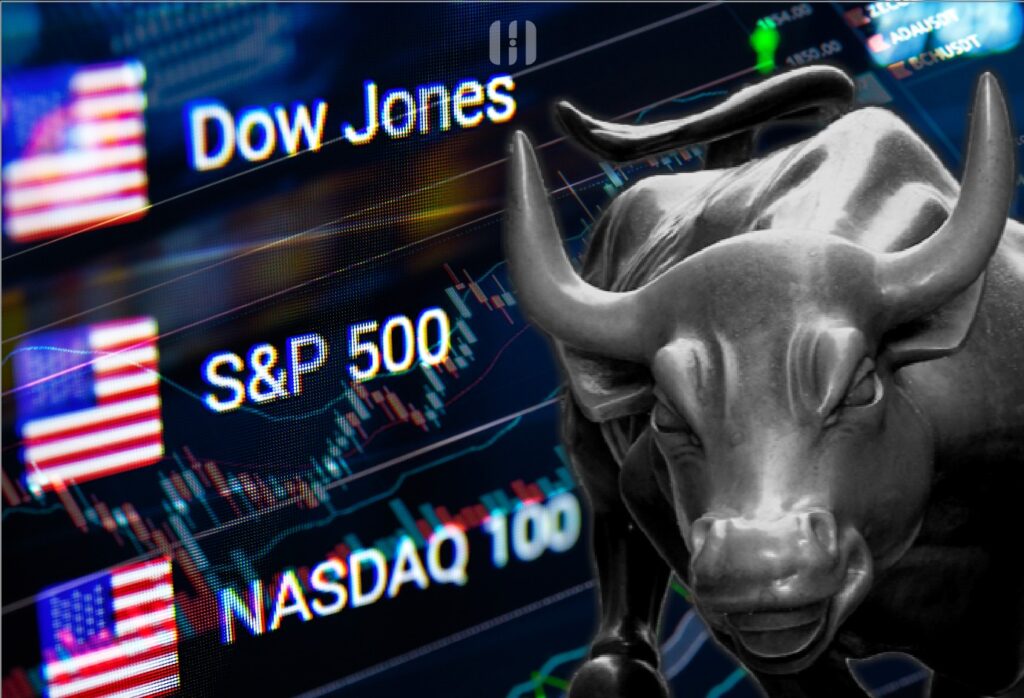
Dow Jones Industrial Average futures rose by 55 points, or 0.1%. S&P 500 futures gained 0.2% and Nasdaq-100 futures were up by 0.4%.
U.S. markets are coming off a positive session. The Dow Jones Industrial Average closed higher by 316 points, or 0.6%. The S&P 500 rallied 1.1%, while the Nasdaq Composite jumped 1.7%.
Stocks posted a comeback one day after the Fed's decision to raise rates by a quarter percentage point — with the suggestion of at least one more rate increase this year — drove major market averages sharply lower Wednesday.
But Thursday's rally — especially in technology stocks — implies many investors are looking past the prospect of a higher-for-longer rate, or inflation, environment, returning instead to an artificial intelligence story that should continue to bolster corporate profits.
"At some point, all cycles end," Brian Levitt, chief global market strategist at Invesco, told CNBC's "Closing Bell." "This one, I don't think it's going to end with the higher Fed funds rate necessarily anytime soon, or higher oil prices. It's going to end when something breaks in the AI trade, when, again, a hyperscaler pulls back on investment, or the market deems the amount of investment to be overdone compared to expected return on invested capital. But that's not the current environment that we're in."
The week concludes Friday with more commentary from Fed officials. Fed Governor Michelle Bowman, a permanent voting member of the policy-setting Federal Open Market Committee, and Kansas City Fed President Jeffrey Schmid, a non-voting member, are set to speak. Investors will look for greater clarity into policymakers' thinking behind Wednesday's unanimous vote for an interest rate hike.
The major stock averages are on pace for a mixed week. As of Thursday's close, the Dow Jones Industrial Average was down by 1.5% this week, on track for a third straight losing week. The S&P 500 was also lower week-to-date, by 0.3%. Only the tech-heavy Nasdaq Composite was set to enter Friday's trading showing weekly gains, up 0.3%.
In his monthly investment note, sent to clients on Thursday, Mark Haefele, chief investment officer at UBS Global Wealth Management, said his team expects the equity rally to continue over the next six to 12 months.
"Of course, rate hikes will not produce more oil or chips, and rising government debt will complicate the outlook," he said. "But we have learned over the years that investors should not automatically assume that geopolitical shocks will cause lasting market weakness or that debt challenges will affect every asset negatively. With earnings growth still strong and lower inference costs stimulating AI adoption, we believe the fundamental supports for the rally remain intact."
In Asia, Japan's Nikkei 225 closed 1.38% higher, while South Korea's Kospi rose 2.66%. Mainland China's CSI 300 closed 1.06% higher. Australia's benchmark S&P/ASX 200 was flat.
Stocks in Europe were last seen broadly lower, with the Stoxx 600 index shedding 0.4% as regional shares retreated from a two-day winning streak.